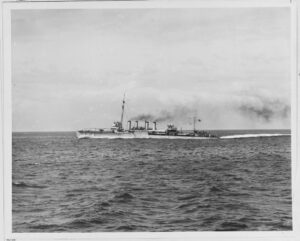
In August 2024, Air/Sea Heritage Foundation was privileged to partner with Ocean Infinity and SEARCH, Inc to find the wreck of the ex-USS Stewart (DD-224), a century-old US Navy destroyer that served under both American and Japanese flags during World War II. This groundbreaking discovery was made off the coast of northern California during a collaborative expedition that also included NOAA’s Office of National Marine Sanctuaries and the Naval History and Heritage Command (NHHC).
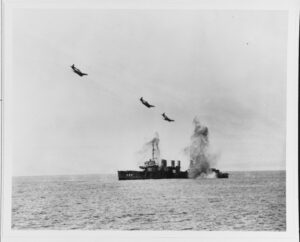
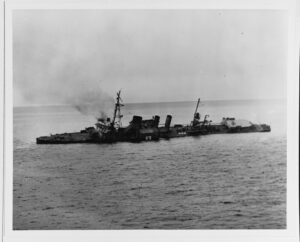
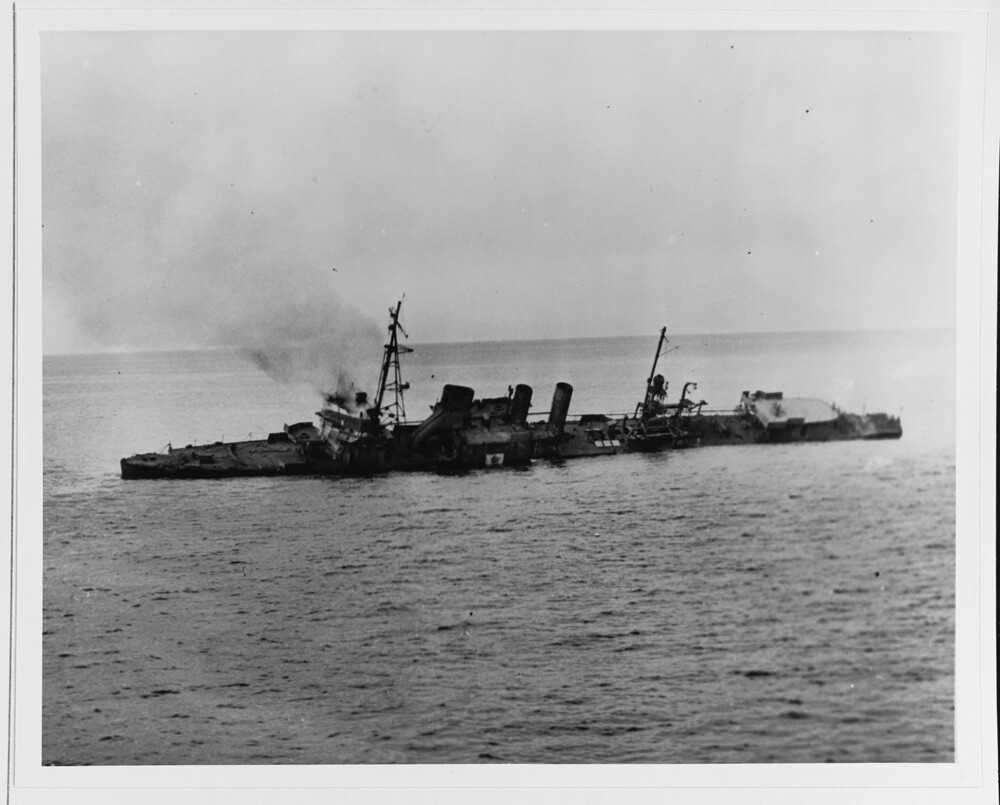
The wreck of what was once known as “the ghost ship of the Pacific” was located resting in deep water approximately 30 miles from shore, within the boundaries of the Cordell Bank National Marine Sanctuary, and in an area consistent with historical accounts of its final disposal. The Stewart had been deliberately sunk 78 years earlier on May 24, 1946 as part of a naval exercise in the post-World War II era, bringing the story of this uniquely historic vessel to its seeming close after a remarkable globe-spanning odyssey.
Laid down in Philadelphia, Pennsylvania in September 1919 and commissioned in September 1920, the Stewart was completed too late to see action in World War I but found itself on the front lines at the start of World War II. In late 1941, the Stewart was based in Manilla as part of the US Navy’s Asiatic Fleet, an understrength collection of older, largely obsolete warships that were suddenly tasked with opposing Imperial Japan’s onslaught after the devastating surprise attack on Pearl Harbor. Damaged during the Battle of Badung Strait in February 1942, the ship entered a repair drydock on Java where a freak accident stranded it just as enemy forces prepared to seize the island. The crew were quickly reassigned or evacuated, abandoning the Stewart only after attempting to disable it with demolition charges and then deliberately scuttling the ship along with the drydock.
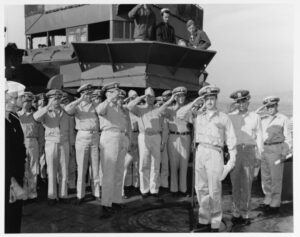
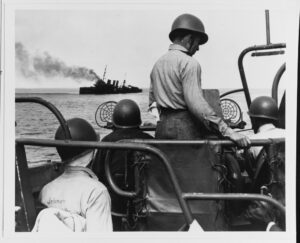
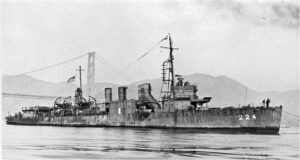
But, after lying for a year on the bottom of Surabaya harbour, the Stewart was resurrected. Raised and repaired, it was then pressed into service with the Imperial Japanese Navy as Patrol Boat No. 102. Soon, far-ranging Allied pilots began reporting the strange sight of an old American destroyer operating deep behind enemy lines. It was not until the Stewart was found still afloat in Kure, Japan at the end of the war that the mystery of the Pacific ghost ship was finally solved. The battered veteran vessel was recommissioned back into the US Navy in what was called an “emotional ceremony” and returned home to San Francisco. There, something like a “burial at sea” was performed: the Stewart serving its country one last time as a target ship, absorbing punishment from aerial rockets, machineguns, and naval gunfire for more than two hours before sinking. In the years that followed, the Stewart’s story drew the interest of historians, archaeologists, and naval enthusiasts, and the rediscovery of its wreck became a top national priority for exploration priority for exploration. Nearly eight decades would pass before it was found again.
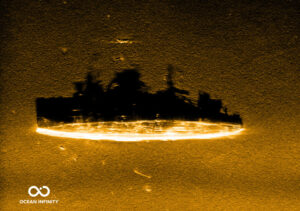
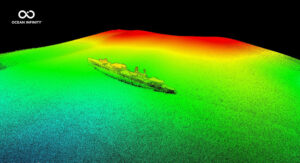
On August 1, 2024 no fewer than three Kongsberg Maritime HUGIN 6000 autonomous underwater vehicles (AUVs) were deployed by Ocean Infinity, one of the world’s leading robotic marine survey companies, to search for the wreck of the Stewart. These state-of-the-art unmanned submersibles, each equipped with high-resolution synthetic aperture sonar (HiSAS) and multibeam echosounder systems, were programmed to conduct an extensive and methodical scan the seafloor that lasted 24 hours. This approach facilitated rapid coverage of a large search area. When the data was retrieved, it revealed the stunning and unmistakeable image of a sunken ship 3,500 feet below the surface.
The mission to find the Stewart had begun months earlier when Andy Sherrell, Director of Maritime Operations at Ocean Infinity America, identified the need to test some of the company’s sophisticated equipment before the upcoming survey season. He consulted with Air/Sea Heritage Foundation President Russ Matthews, and with former NOAA Director of Maritime Heritage Dr. James Delgado, now Senior Vice President of SEARCH, one of the nation’s largest cultural resources company. Matthews and Delgado, with a host of valued colleagues, have worked for years to pinpoint significant sunken vessels and aircraft, connecting with expert partners like Ocean Infinity and seeking collaborative opportunities to illuminate significant but oft-forgotten relics in the ocean’s depths. For example, a previous (2020) joint endeavour led to the discovery of the wreck of the storied battleship USS Nevada (BB-36)—a veteran of the Pearl Harbor attack, D-Day landings, and Bikini Atoll atomic bomb tests that now rests in the deep sea off Hawaii. Sherrell, Mathews, and Delgado eagerly discussed using Ocean Infinity’s impending San Fransico-area testing and calibration program to search for another important target of great public interest. USS Stewart seemed the obvious choice, and a research application was submitted to authorities at NOAA’s Cordell Bank National Marine Sanctuary, who, with the US Navy’s concurrence, issued a permit to conduct a non-disturbance survey for the wreck to Matthews, Delgado, and the team on board the Ocean Infinity vessel Island Pride. Matthews also provided a critical source of evidence in the form of previously classified logbook entries from the US Navy ships involved in sinking the ex-USS Stewart in 1946, which he had retrieved from the National Archives and Records Administration.
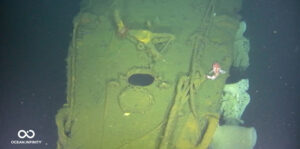
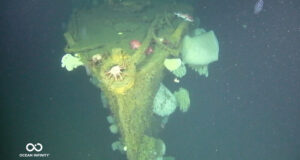
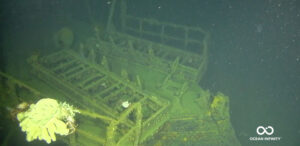
Preliminary sonar scans revealed that the Stewart is largely intact and that its hull—which remains sleek and purposeful—rests nearly upright on the seafloor. This level of preservation is exceptional for a vessel of its age and makes it potentially one of the best-preserved examples of a US Navy “four-stacker” destroyer known to exist. The wreck’s condition offers invaluable insights into early twentieth-century naval architecture and technology. Following the initial discovery, Ocean Infinity’s team aboard the Island Pride conducted an additional high-resolution sonar survey, then launched a detailed visual inspection of the site using a camera-equipped remote-operated vehicle (ROV). The video feed was transmitted live from the sea floor using a virtual satellite link to experts and various stakeholders on shore. This group included Matthews and Delgado, as well as National Marine Sanctuaries Chief Historian Willie Hoffman, SEARCH maritime archaeologist Dr. Michael Brennan, and others, who all worked closely with Ocean Infinity’s highly skilled crew as they explored the deep-sea wreck in real time. Also participating in the dive was Rear-Admiral Samuel Perez Jr., USN (Ret), the Executive Chairman of Ocean Infinity America. Admiral Perez’s insights as a former naval-surface warfare officer were invaluable in assessing the wreck and the damage caused by the bombardment that sank it. The admiral stated, “The discovery and survey of the USS Stewart highlights an important chapter in our Naval history. It was made possible through the exceptional collaboration of this unique team of marine archaeologists and the superb work of the Ocean Infinity crew. We are proud to be a part of this historic endeavour.”
While watching the evocative video from the seafloor, Matthews recalled reading in the historical record about a touching tribute from the sailors who brought the Stewart home. The sailors took to calling their charge “RAMP-224,” which is a combination of the vessel’s navy hull number and a period slang term for returning prisoners of war or Recovered Allied Military Personnel. “It’s clear they thought of Stewart more like a shipmate than a ship,” Matthews said, “and I know I speak for the entire expedition team when I say that we’re all very satisfied to have helped honor the legacy and memory of those veterans once again.” Dr. Delgado added, “The USS Stewart represents a unique opportunity to study a well-preserved example of early twentieth-century destroyer design. Its story, from US Navy service to Japanese capture and back again, makes it a powerful symbol of the Pacific War’s complexity.”
Rear Admiral Samuel J. Cox USN (Ret), the Director of Naval History and Heritage Command, and Curator for the US Navy, also weighed in, saying, “The US Navy greatly appreciates the professionalism of the team that located the wreck of the USS Stewart. Whether lost in battle or sunk as a target, a warship remains sovereign property in perpetuity. It is important to know the location and condition of such wrecks so that they may be protected from unauthorized disturbance under the US Sunken Military Craft Act. The Stewart provides an opportunity to remember the valour of the US Asiatic Fleet during the darkest days of World War II, compelled to sacrifice ships and many brave lives to buy time for a nation that was unprepared for war. That lesson remains valid today.”