
The search for Clipper Endeavor is an ongoing effort led by Air/Sea Heritage Foundation to find the wreckage of Pan American World Airways Flight 526A that crashed off San Juan, Puerto Rico in April 1952. Locating and identifying the site will allow characterization and protection of this important cultural heritage resource, while hopefully spurring a greater awareness and appreciation for its historical significance.
A new hunt for the sunken plane began in August 2019 when NOAA issued a call for input to identify areas of interest in the mid-Atlantic, US east coast and Caribbean. Air/Sea Heritage president Russ Matthews, still fresh from the first “Search for Samoan Clipper” expedition a month earlier, and full of information about Pan American Airways history, recalled the story of Clipper Endeavor’s loss near Puerto Rico and immediately initiated a new ASHF project.
Extensive archival research quickly uncovered a wealth of solid, contemporaneous information on the location of the crash. It is known that Captain Burn maintained radio contact with the CAA control tower at Isla Grande throughout the entirety of Clipper Endeavor’s final flight, which lasted no more than 9 minutes. Meanwhile, crew members aboard a US Air Force C-47 conducting a navigational training exercise just a few miles away observed the ditching and rushed to the scene, circling overhead as the downed plane sank. The US Coast Guard Rescue Coordination Center San Juan immediately dispatched two PBY amphibians to the spot, where one orbited the area while the other landed on the water to pick up survivors. They were soon joined by the USCG buoy tender Bramble plus two more USAF air-sea rescue planes which also set down to assist. A large fuel slick lingered on the surface for several hours, marking where Clipper Endeavor went down (approximately 11 miles from the airport and 4.5 miles off the northern coast of Puerto Rico).
In early 2020, at the request of Air/Sea Heritage Foundation, sonar expert Gary Fabian combed through existing multibeam echo sounder (MBES) data recorded near the reported coordinates and learned that the NOAA ship Okeanos Explorer had previously surveyed the vicinity not once, but twice. His analysis revealed a relatively flat and featureless seafloor comprised of softer sediment, ranging in depth between 500 and 600 meters. Within one nautical mile or less from the US Coast Guard’s estimated crash position for Clipper Endeavor Gary plotted four intriguing anomalies, all of which appeared in both the backscatter and bathymetric readings. Through the generosity of colleagues at NOAA and the Schmidt Ocean Institute, a pair of “stop and drop” ROV investigations of the suspected Clipper Endeavor targets near Puerto Rico were undertaken by the research vessels Okeanos Explorer and Falkor (Too) in August 2022 and February 2023 respectively. All four of the prime anomalies were examined successfully and eliminated as geology.
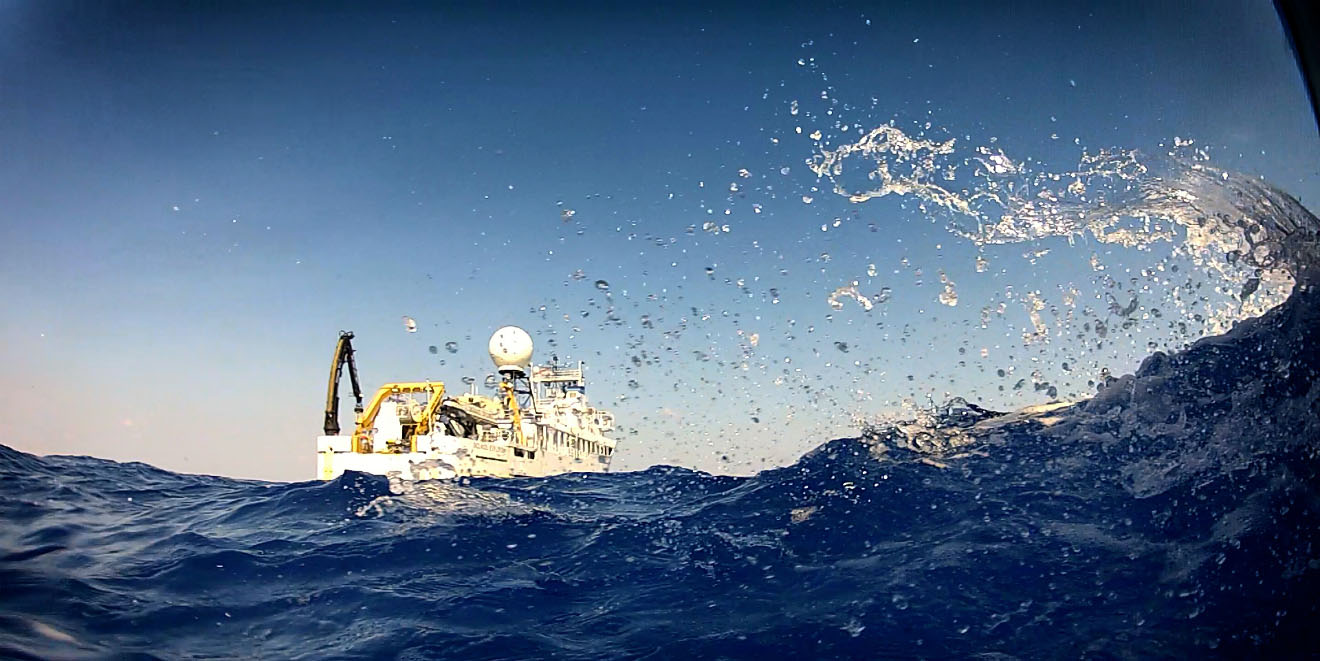
Recognizing the need to cast a much wider net and generate far higher resolution sonar data of the presumed wreck site, Air/Sea Heritage Foundation reached out to old friend and colleague Evan Kovacs of Marine Imaging Technologies, Inc. An innovative engineer, expert technical diver, and gifted videographer, Kovacs’ experience in underwater survey and documentation stretches from the Apollo 11 F1 engine recovery to the RMS Titanic 3D photogrammetry mission and everything in-between, including a 2018 Air/Sea Heritage Foundation mission that performed the first subsea laser scanning of an extremely rare WWII era US Navy TBD-1 Devastator torpedo bomber in the remote Marshall Islands. Together they organized a dedicated survey mission to search for the wreck of Clipper Endeavor in April 2024. Additionally, they partnered with BlueTide Puerto Rico, a San Juan based nonprofit that operates BlueManta, a highly advanced, capable, and rugged 73-foot research vessel and the perfect platform to utilize the sophisticated array of towed side-scan sonar and deep diving ROV (remote operated vehicle) that the team brought to bear.
Getting underway on April 8, 2024 the mission was beset by unusually strong winds and heavy seas, which kept either kept the team in port or prevented safe deployment of the survey gear for three days out of an intended five day expedition. By extending an extra day and through dogged and persistent efforts, the project partners pushed through marginal/stormy conditions to ultimately cover and eliminate a core section of the prime target area measuring roughly 10 square miles. However, the poor weather cost them dearly, not only in terms of lost search time, but in the final catastrophic failure of a key piece of equipment (a bracket supporting the USBL tracking pole) from metal fatigue induced by repeated high waves, which rendered the sonar and ROV units unable to navigate accurately subsea. Effectively blind and out of time, the team was forced to quit for the season without expanding into their planned secondary search zones.
Everyone involved with the project is certain that the wreck of Clipper Endeavor must have been close .. and equally sure that we will be back.
A film crew from the long-running hit adventure-documentary series Expedition Unknown, with host Josh Gates, participated in the recent mission, documenting the field work in their uniquely entertaining and informative style, while providing a moving and long overdue tribute to the Clipper Endeavor tragedy.
EXU “Search for Pan Am’s Clipper” debuts Wednesday, Oct 23 at 9:00pm EDT on Discovery (and available for streaming later on Max and Discovery+)